By Michael R. · Updated 2026-08-16 · 19 min read
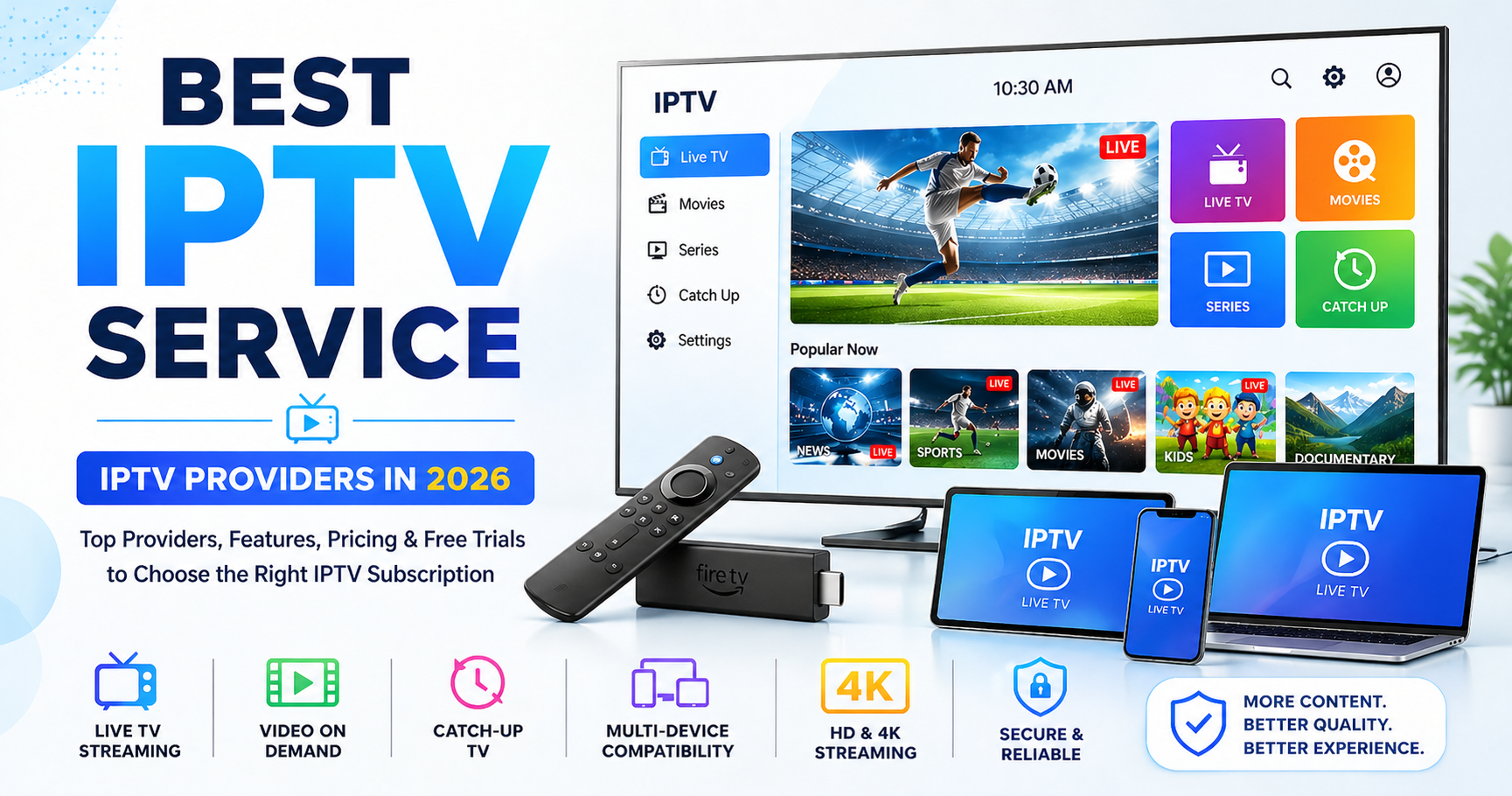
“IPTV service” is one of those phrases you see everywhere — in Reddit threads, in YouTube comments, on seller websites — but most explanations are either too technical or full of hype. Here’s the honest version: IPTV (Internet Protocol Television) delivers television through the same internet connection you already pay for. Instead of relying on cable lines or a satellite dish, the service sends TV signals as data packets over your broadband.
That simple difference changes everything. It affects the price you pay, the devices you can watch on, the number of channels you can access, and the risks you take on. The image above shows a typical IPTV home screen — live channels, films, and a search bar all in one place.
This complete guide walks through the technology step by step, the real benefits, the genuine limitations, the alternatives, and the exact setup process, with no marketing fog. By the end, you’ll know whether IPTV is worth your money or whether you should stick with your current setup.
What Is an IPTV Service, Exactly?
IPTV service means television content delivered over an IP network — a managed, structured version of the internet connection in your home. The key difference between IPTV and traditional TV is that broadcast signals aren’t sent to everyone at once. With cable and satellite, every channel streams at all times and your box filters out the one you want. With IPTV, each stream is sent to you individually, on demand, in the form of compressed data packets.
When people talk about “an IPTV service” today, they usually mean one of three things:
- Telecom-grade IPTV — the kind delivered by large internet providers as part of your package. Licensed, expensive, and usually locked to a set-top box.
- Independent licensed services — smaller companies that purchase legal distribution rights for specific content and sell it directly to viewers.
- Grey-area providers — services that resell TV streams without official license deals. These are the ones discussed on Reddit and in streaming forums. They offer big channel counts at low prices, but with continuity and legal risk attached.
The rest of this guide focuses mostly on the second and third types, because that’s what most people are actually searching for when they type “iptv service” into Google.
Most IPTV services work in three formats:
- Live TV — real-time channels like sports, news, and entertainment.
- Video on Demand (VOD) — a library of films and series, organized much like Netflix.
- Time-shifted TV — catch-up content that lets you watch programs from the past few days, plus start-over on live channels.
An electronic program guide (EPG) organizes all of this into a familiar scrolling list of channels with descriptions, so the experience still feels like traditional television.
How IPTV Service Works (Step by Step)
The technical path of a channel from studio to your screen goes through six stages:
- Content acquisition — The provider captures live TV signals, usually from satellite feeds or direct studio distribution, and receives digital files from content owners.
- Encoding and transcoding — Raw video is compressed into internet-friendly formats like H.264 or H.265, which balance quality and bandwidth use.
- Distribution via CDN — Encoded streams are pushed to content delivery networks so that a viewer in London connects to a server in London, not one on the other side of the world. This is why you see “best IPTV service no buffering” claims — a stronger CDN means less buffering.
- Playlist or portal authentication — Your device loads a playlist (usually an M3U file) or uses an Xtream Codes portal address. This tells the app which channels and VOD sources your subscription includes.
- Player app or middleware interface — Apps like TiviMate, IPTV Smarters, or a provider’s own application turn the raw stream list into a polished TV guide with channel logos, EPG data, and categories.
- Streaming and playback — When you click a channel, your app sends a request, the server responds with the stream, and your device buffers a few seconds before playing. Because it’s a one-to-one connection, you can pause live TV on most services.
If you’ve ever set up a Firestick, you’ve probably seen part of this in action without realizing it. The app does the heavy lifting; the playlist is just a long list of stream URLs.
Concrete Benefits of a Good IPTV Service
A reliable IPTV service offers advantages that cable and satellite simply can’t match:
Price and value. Independent IPTV services are typically far cheaper than cable packages. You pay a fraction of the monthly fee and get a bigger channel lineup. The catch is that price stability depends on the provider’s continuity, but in the short term, the value is real.
Device freedom. The best IPTV service for Firestick 2025 and other strong providers support many devices: Firestick, Android TV, Apple TV, smart TVs from Samsung and LG, phones, tablets, and computers. One subscription often allows more than one concurrent connection.
International channels. For expats, immigrants, or anyone who wants to keep up with home-country content, IPTV is unmatched. News, sport, entertainment, and children’s channels from almost any region sit under one subscription.
Catch-up TV. An affordable IPTV service with catch-up TV means you don’t need a personal DVR. Shows that aired earlier in the week appear in a dedicated section right alongside live TV.
On-demand catalog included. Many IPTV subscriptions bundle a VOD library of films and series into the same price, giving you live TV and a movie library in one place.
Multi-screen households. Because most subscriptions allow simultaneous connections, family members can watch different channels on different screens at the same time.
Honest Limitations You Need to Accept
There’s no perfect TV solution, and IPTV has real limitations that most sellers won’t mention.
Your internet connection decides everything. IPTV requires a stable, consistent connection. Every other household download, video call, or gaming session competes for bandwidth. For HD streaming, you want at least 25 Mbps; for 4K, more. If you live in a rural area with spotty service, IPTV will frustrate you.
Most independent providers sit in a legal grey area. They don’t hold broadcast licenses for every channel in their lineup. That means a service can be shut down without notice if a rightsholder acts against it. An active playlist today can be a dead playlist tomorrow.
Customer support is often thin. You usually communicate through Telegram, WhatsApp, or an email ticket. There’s no phone number to call and no technician. Good support is responsive support, but in a crisis, don’t expect a polished corporate experience.
Buffering risk exists even with good providers. Server congestion during peak hours, long-distance connections, and a weak home network all cause buffering. No provider can honestly guarantee zero buffering forever.
Sideloading requirements. Many high-quality player apps are not on official app store shelves. Installing them means enabling “unknown sources” and adding APK files — a step some people find annoying or insecure.
VPNs and local laws. In some countries, streaming unlicensed IPTV content carries legal risk, so many users pair the service with a VPN, which adds configuration overhead.
Pros and Cons at a Glance
✓ Benefits & Pros
Much lower cost than cable or satellite
Huge channel variety, including global content
Works on Firestick, smart TVs, phones, tablets, and PCs
Catch-up TV and VOD usually included
Multiple simultaneous connections are the norm
Fast setup without a technician visit
✗ Limitations & Cons
Depends on fast, stable internet
Legal grey area for many independent providers
Services can disappear without notice
Support is chat-based most of the time
Buffering possible during peak hours
Sideloading APK apps is sometimes required
RECOMMENDED RESOURCE
iptv service
See current details, seasonal promos, and full tier packages.
Learn more about iptv service →
IPTV Service vs. Cable vs. Netflix-Style Streaming
The channel list pictured above is something no traditional cable provider would show you — hundreds of stations organized by language and genre. The table below compares IPTV against the two main alternatives honestly, so you can see where each option wins.
Read independent network latency reviews and hardware specs.
Find Out More About iptv service →Who Is an IPTV Service Actually Good For?
The overpaying cable subscriber. You watch the same 15 channels but pay for 200. IPTV gives you a leaner bill and a much wider lineup.
The expat or international household. Watching news, sports, and series from your home country is the single most common reason people switch to IPTV. Good services group channels by region and include local programming you can’t get anywhere else.
The sports fan who refuses premium add-ons. International sports packages on cable cost a fortune. On IPTV, the same games are usually part of the base subscription, including many niche leagues.
The multi-screen family. Parents watching movies in the living room while kids watch cartoons in the bedroom — IPTV’s simultaneous connections handle this easily.
Anyone who hates the set-top box. IPTV runs on the device you already own. No technician, no coax cable, no 12-month contract with a box you must return.
Who should skip IPTV? People with unstable internet connections, users who want a fully legal zero-risk setup, and anyone who doesn’t feel comfortable installing apps from outside official stores. There’s nothing wrong with cable or Netflix; IPTV is a tool, not a reason to abandon everything else.
How to Get Started With IPTV Service (Practical Steps)
- Test your internet speed. Run a speed test on the device you intend to use. You want at least 25 Mbps on a wired connection or strong 5GHz Wi-Fi. Anything less will cause buffering on HD channels.
- Decide which device you’ll use. This matters more than you think. Firestick users look for apps that install easily via Downloader; smart TV users need to check whether the app exists for their platform. If you’re unsure, a cheap Android TV box eliminates most compatibility problems.
- Find the provider carefully. Search Reddit (“iptv service review Reddit” threads can be genuinely helpful) and read what real users say about uptime, support response time, and channel stability. Where to buy reliable IPTV service? Only from the provider’s own website — not from random DMs or comment sections.
- Buy one month first. Never start with a 12-month plan. A single month is the cheapest trial you can buy. The IPTV service monthly subscription vs. yearly comparison only becomes relevant after you’ve confirmed the provider is stable.
- Install the player app. The provider will recommend one — often TiviMate, IPTV Smarters, or their own app. If sideloading is required, do this step before entering any credentials.
- Load your playlist or portal. Enter the M3U URL or Xtream Codes portal details into the app. Most apps fetch the full channel list within seconds.
- Set up the electronic program guide. Choose an EPG source from the provider or pull the one tied to your subscription. A working EPG is the difference between feeling like a hacked stream list and feeling like real television.
- Test at peak time. Weekend evening between 7 and 10 pm is the real test. If channels buffer at that hour, you’ve seen the provider’s true quality. Use this test to decide whether to stay monthly or commit longer.

Final Thoughts
IPTV service is a legitimate and increasingly popular way to watch television, but the experience you get depends almost entirely on two things: your internet connection and the provider you choose. The technology is sound, the value is strong, and the flexibility is genuinely useful for many households. Yet the grey-market reality means you need to approach it carefully — start small, test at peak hours, and keep a backup plan like a VPN or a legal streaming app for the day a stream stops working.
Setting up a comfortable viewing corner, like the one pictured above, is straightforward once you have a working service on your TV. If you’re ready to explore a reliable provider, the featured platform below publishes transparent pricing, setup guides, and multi-device support, so you can check current plans without guessing.
Featured Streaming Selection:
View the iptv service Platform →Affiliate Disclosure: Clicking this secure link verified by our network supports our team through standard partnership terms at zero extra cost to your invoice.
Frequently Asked Questions
This article contains affiliate links. Our editorial analysis remains independent.